
-

Radboud University
Africa Millimetre Telescope to bring black holes into sharper focus for movies
An international consortium led by Radboud University has secured a contract agreement for the construction of a radio telescope that will become the Africa Millimetre Telescope (AMT) in Namibia. The new telescope will be an essential addition to the global Event Horizon Telescope (EHT) network, which produced the historic first images of black holes. The AMT is the first African node to the global EHT network, filling a key gap in the array and providing better sensitivity to image rapid motions around black holes and to detect flaring radio sources. The AMT consortium, consisting of Radboud University, University of Oxford, University of Amsterdam, University of Namibia, University of South Africa, and University of Turku as associated member, has found a specialised partner in mtex antenna technology, which will further develop and build a proven telescope design specifically for the AMT project. The project further strengthens the international position of Radboud University in astronomical research.
-

CBC - Canada's Paralympic Network
Astronomers are capturing video of a black hole for the first time
Contrary to science fiction, black holes are not portals to other dimensions or cosmic vacuum cleaners that swallow up everything around them. “The media always paints black holes as these pits of despair, and everything falls in, but they're much more fun than that,” astrophysicist Sera Markoff told Quirks and Quarks host Bob McDonald. Markoff is part of a global team working to capture the first-ever video of a black hole, a scientific leap that could reveal how these mysterious cosmic objects behave.
-
CBC - Canada's Paralympic Network
You may have seen Black Hole, the image, captured by Event Horizon Telescopes around the world, but have you heard of the upcoming Black Hole, The Movie? This week, astronomers launched a new campaign to capture video footage of the supermassive black hole pulsing at the heart of the Messier 87 galaxy. By capturing its movements, astronomers hope to answer big questions about the nature of black holes and the role they play in shaping our universe — and show that black holes are more than the cosmic “pits of despair” we often make them up to be. We spoke with: Sera Markoff is the new Plumian professor at Cambridge University and a Professor of Theoretical Astrophysics at the University of Amsterdam. Vincent Fish is a research scientist at MIT’s Haystack Observatory. They both sit on the science board of the Event Horizon Telescope, the global telescope array that is currently capturing the data.
-

The Guardian
Revolutionary imaging of black hole aims to prove they are not ‘evil vacuum cleaners’
Dark, hungry and inescapable: black holes are often portrayed as the ultimate cosmic villains. But now astronomers are preparing to capture a movie of a supermassive black hole in action for the first time, in observations that could help reveal another side to these elusive – and perhaps misunderstood – space objects. The Event Horizon Telescope (EHT) will track the colossal black hole at the heart of the Messier 87 galaxy throughout March and April with the aim of capturing footage of the swirling disc that traces out the edge of the event horizon, the point beyond which no light or matter can escape.
-

University of Cambridge
Sera Markoff appointed 17th Plumian Professor of Astronomy
Sera Markoff has been appointed Plumian Professor of Astronomy and Experimental Philosophy at the University of Cambridge. One of the oldest named professorships in the world – founded in 1704 by Thomas Plume, after Sir Isaac Newton oversaw its creation – previous Plumian Professors include distinguished astronomers Sir Arthur Eddington, Sir Fred Hoyle, and Lord Martin Rees. Professor Markoff – also announced as a Fellow at Newnham College – is an internationally recognised expert on black hole astrophysics, working at the interface with astroparticle physics. Her research focuses on understanding the extreme interactions of matter occurring around compact objects like black holes, and how they determine the ways in which black holes affect their surroundings. She is a founding member of the Event Horizon Telescope collaboration, which brought together an array of telescopes spanning the globe and received worldwide media coverage when it captured the first groundbreaking image of a black hole and the ‘shadow’ of its event horizon in 2019.
-

University of Amsterdam
The European Research Council (ERC) has awarded a Synergy Grant, named “BlackHolistic”, of 14 million Euro to a team of Dutch, British, Finnish, and Namibian astronomers to make colour movies of black holes. The team, among whom Professor Sera Markoff of the University of Amsterdam, will build the first ever African millimetre-wave radio telescope in Namibia to achieve their goal. The telescope will take part in the global Event Horizon Telescope network that became famous for making the first image of a black hole. The new grant will help to transform this network from making still images towards making movies and to understand black holes across the entire Universe.
-

SciTech Daily
New high resolution simulations suggest the origin of black hole flares
Researchers at the Flatiron Institute and their collaborators found that breaking and reconnecting magnetic field lines near the event horizon release energy from a black hole’s magnetic field, accelerating particles that generate intense flares. The findings hint at exciting new possibilities in black hole observation.
-

Scientas
Het allereerste zwart gat dat wetenschappers ontdekten, blijkt veel zwaarder dan gedacht
Een internationaal team van onderzoekers – waaronder ook astronomen van de Universiteit van Amsterdam – hebben ontdekt dat het zwarte gat Cygnus X-1 veel zwaarder is dan lang werd aangenomen. Het is niet 15, maar maar liefst 21 zonsmassa’s zwaar. Dat is te lezen in het blad Science. De herziene massa van Cygnus X-1 zorgt voor enige opwinding onder sterrenkundigen. Het gat tussen kleine stellaire gaten en middelzware zwarte gaten is met de ontdekking namelijk weer een stukje kleiner geworden.
-

Chopping Block
“Chopping Block” interview about diversity in Astro with Visceral Change founder Sherard Robbins
“Those who say it can’t be done are usually interrupted by those doing it.” Visceral Change is a Multicultural Organizational Development Consultancy specializing in training, development, and institutional restructuring. We help organizations center their professional frameworks and practices around diversity, equity, and inclusion.
-
Het Parool
De meeste onbekende niet-Nederlander op de klapstoel!
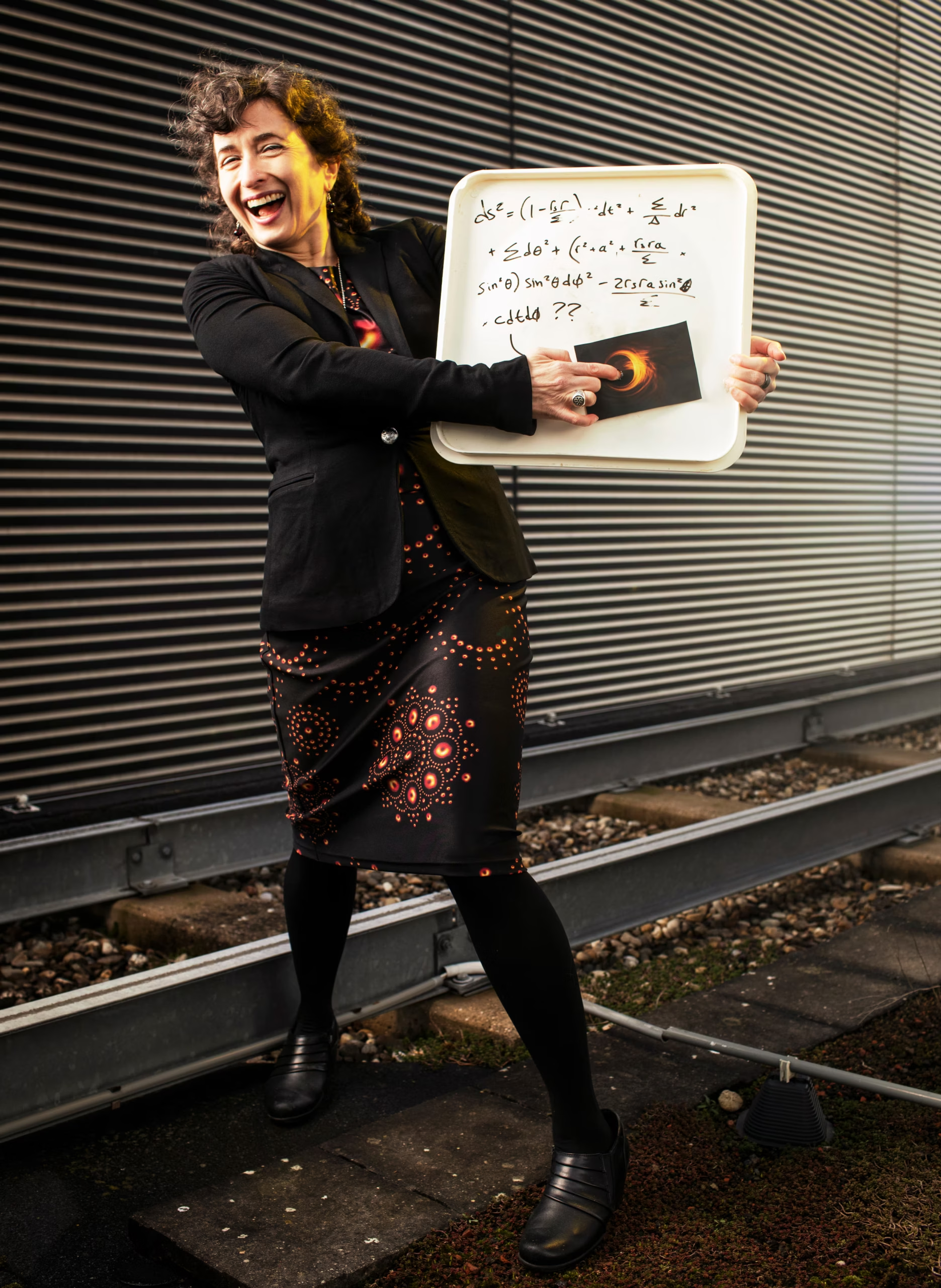
Van zwarte gaten weten we ongeveer hoe ze werken en toch passen ze niet goed in ons huidige beeld van de natuurkunde. We kunnen ze beschrijven, maar we weten nog steeds niet precies hoe ze ontstaan. Op de een of andere manier wijzen ze op een mysterie en tegelijk spelen ze een enorme rol in het universum. En het zijn heel vreemde dingen, natuurlijk.
-
RAS/EHT
EHT Awarded the UK Royal Astronomical Society’s 2021 Group Achievement Award
This image has already inspired millions and will continue to do so. It represents an important milestone in human ingenuity and scientific endeavour, and is opening new doorways to study the physics of accretion around super-massive black holes in completely unprecedented ways. The realisation of the EHT represented a formidable challenge and was made possible only by decades of hard work and commitment by thirteen stakeholder institutions, a variety of agencies, and more than three hundred forty researchers. This is one of the finest examples of an achievement resulting from close collaboration by researchers from around the World.
-
NWO Twitter
NWO Domain Science Diversity Initiative Award!
The Diversity Initiative Award goes to @SpacegeekSera for introducing primary school children to astronomy & physics and promoting diversity in the field. https://youtu.be/T2IvvEPQcgc